
© irene waters 2016
© irene waters 2016

© irene waters 2016
© irene waters 2016
The Great Geysir (originally just Geysir) is found in southwestern Iceland in the Haukadalur valley.
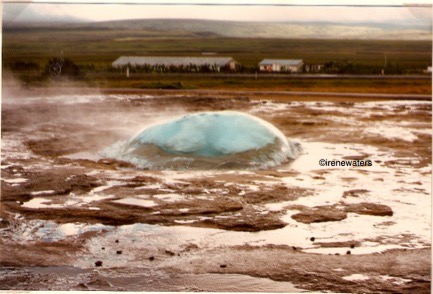
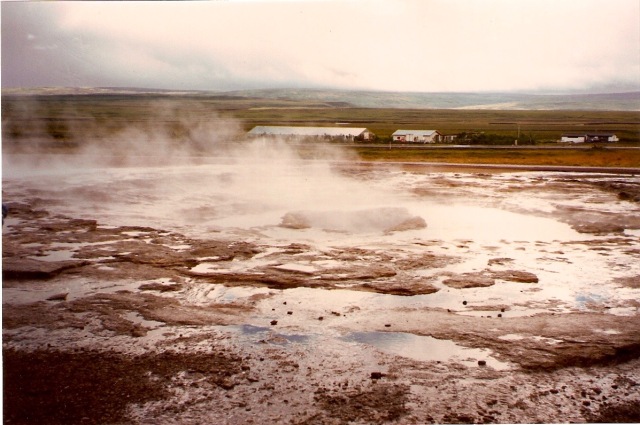
In recent years it has become infrequent in its eruptions so on my visit in 1990 it was Strokkur geyser situated 50 metres from the Great Geysir that I took these photos. It is the world’s most persistent geyser and erupts in a continuous cycle, transmogrifing from an empty hole in the ground, gradually being filled by an ever enlarging bubble of water until the bubble bursts and a stream of waters rises high around 40 – 50 metres, gradually clearing until again there is just a hole in the ground. This cycle is seen in the photos above. Firstly the vent is visible with just a little steam being seen coming from it.
The Great Geysir was first described in print in the 18th century but accounts date back to 1294. Geologically the sinter indicates activity of the geysir for 10,000 years. It is strongly related to earthquake activity with the spout increasing in height when there is more seismic activity. There has been a period of time when there have been no eruptions at all for several years. The height of its blows are reported at 170 metres in 1845.
Strokkur was first reported in 1789 when an earthquake opened a vent. It stopped its activity for awhile in the 1890’s but with renewed earthquake activity which either unblocked or opened a new conduit it recommenced it’s frequent activity and has been regularly performing ever since.
Many of the photographs seen on the internet are of Stokkur rather than the Great Geysir as they are labelled but I think this is understandable as when I went there I was told I was going to the Geysir. I thought that is what I was watching with awe as the bubble rose and burst. It was not until later that I discovered that the area is labelled Geysir and encompasses both the geysers and the hot springs.
In response to Weekly photo challenge