
Today we have a choice. Firstly, we can reflect on being a teacher or a student. The only reflection that I am going to share is that I learnt very early in my teaching that you have to know what you are talking about. My first lecture I didn’t and I learnt that I stutter when very stressed. From that point on I prepared my lessons much more thoroughly.
The other task we could do for this challenge was to teach something that only I know. I can assure you I am by no means the only person that knows something about the heart and we should be grateful that there are many more that know a lot more about the heart than I profess to know. For those that don’t knowa lot about the heart I am going to give a quick lesson in understanding the workings of the heart and what happens when one of these systems goes haywire. I hope that at the end of the lesson you will have a greater understanding of the heart and have a basic idea of what it means when you hear the terms heart attack, heart failure and atrial fibrillation.
The heart is situated in the chest between the lungs with two thirds of it on the left side. If you clench your fist – this is the approximate size of your heart and it weighs less than a pound.
The interior of the heart is divided into four chambers. Two upper receiving chambers known as the atria and two lower pumping chambers known as ventricles.
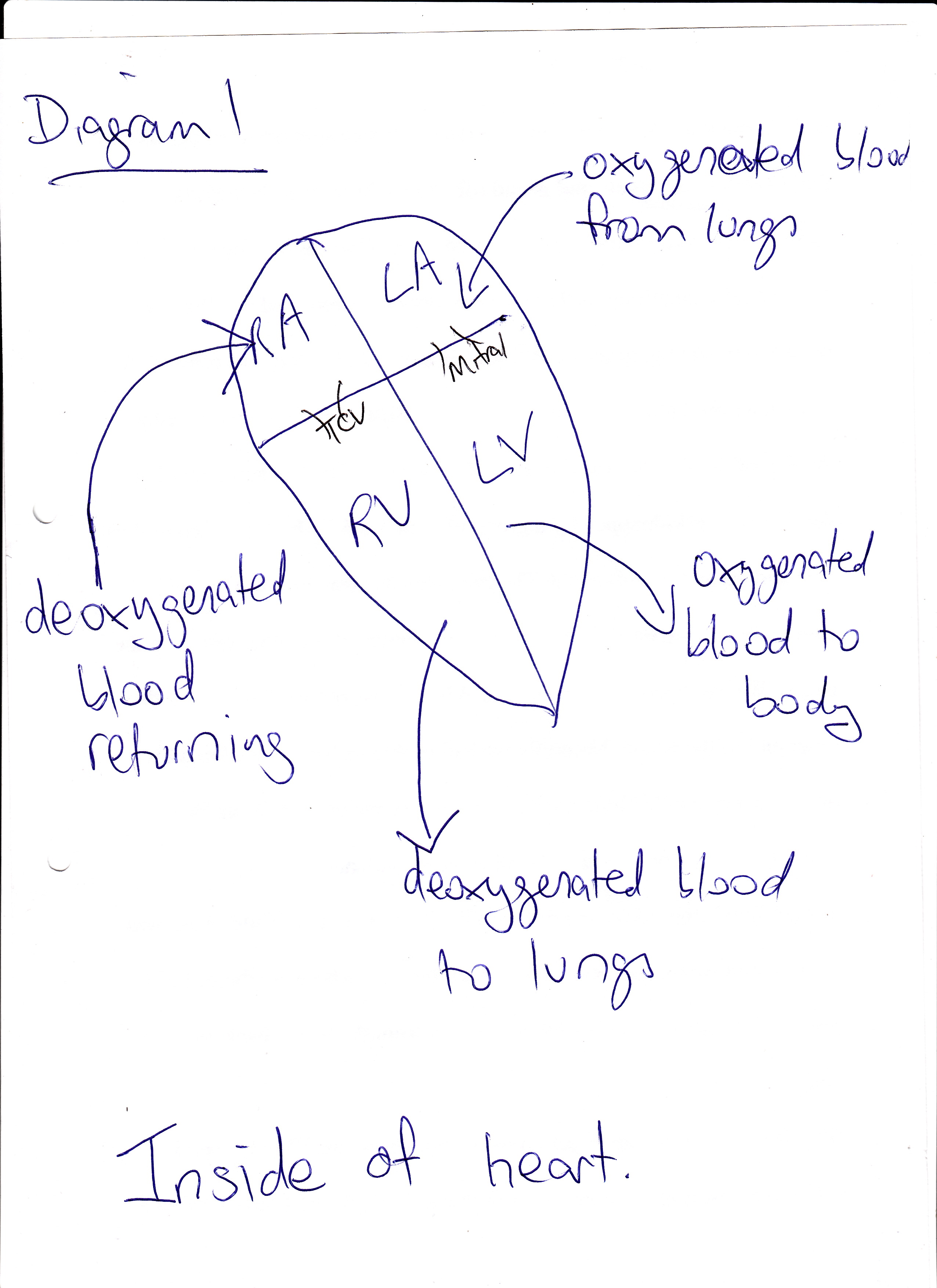
© irene waters 2014
The heart is a pump which beats 100,000 times a day pumping 3,784 litres of blood per day through over 60,000 miles of blood vessels (enough to encircle the world almost twice). In a 70 year lifespan the human heart beats more than 2.5 billion times. The purpose of the pump is to circulate blood around the body delivering oxygen to all the tissues and organs including the heart itself. Along the way it picks up waste products which are removed as the blood is filtered through the kidneys, liver and lungs.
Blood without oxygen enters the right atria from the body and goes via the tricuspid valve into the right ventricle where it is pumped to the lungs. (trivia question: the pulmonary artery is the only artery to carry deoxygenated blood whilst the pulmonary vein is the only vein to carry oxygenated blood.)
If there is a problem with the pump and insufficient blood is pumped out and has difficulty returning to the heart which leads to either fluid in the legs or fluid in the lungs (or both) this is known as heart failure. One of the factors of heart failure is the inability of the heart muscle to contract properly often due to overstretching of the muscle fibres. If you think of a pair of men pyjama pants. When first bought the elastic stretches and snaps back to keep the trousers up. With use the elastic looses its stretch and eventually no longer snaps back to do the job it was supposed to do. This is similar to a heart in failure. To diagnose this they often do echocardiography. Here it can be asscertained how well the muscle is pumping. The ejection fraction which is the amount of blood pumped out of the left ventricle with each contraction expressed as a percentage is also obtained from this test. Normal is 55 – 70%.
© irene waters 2014
Like any pump something has to make it work. A farm pump could use diesel or electricity. In the hearts case it is electricity which makes it work.
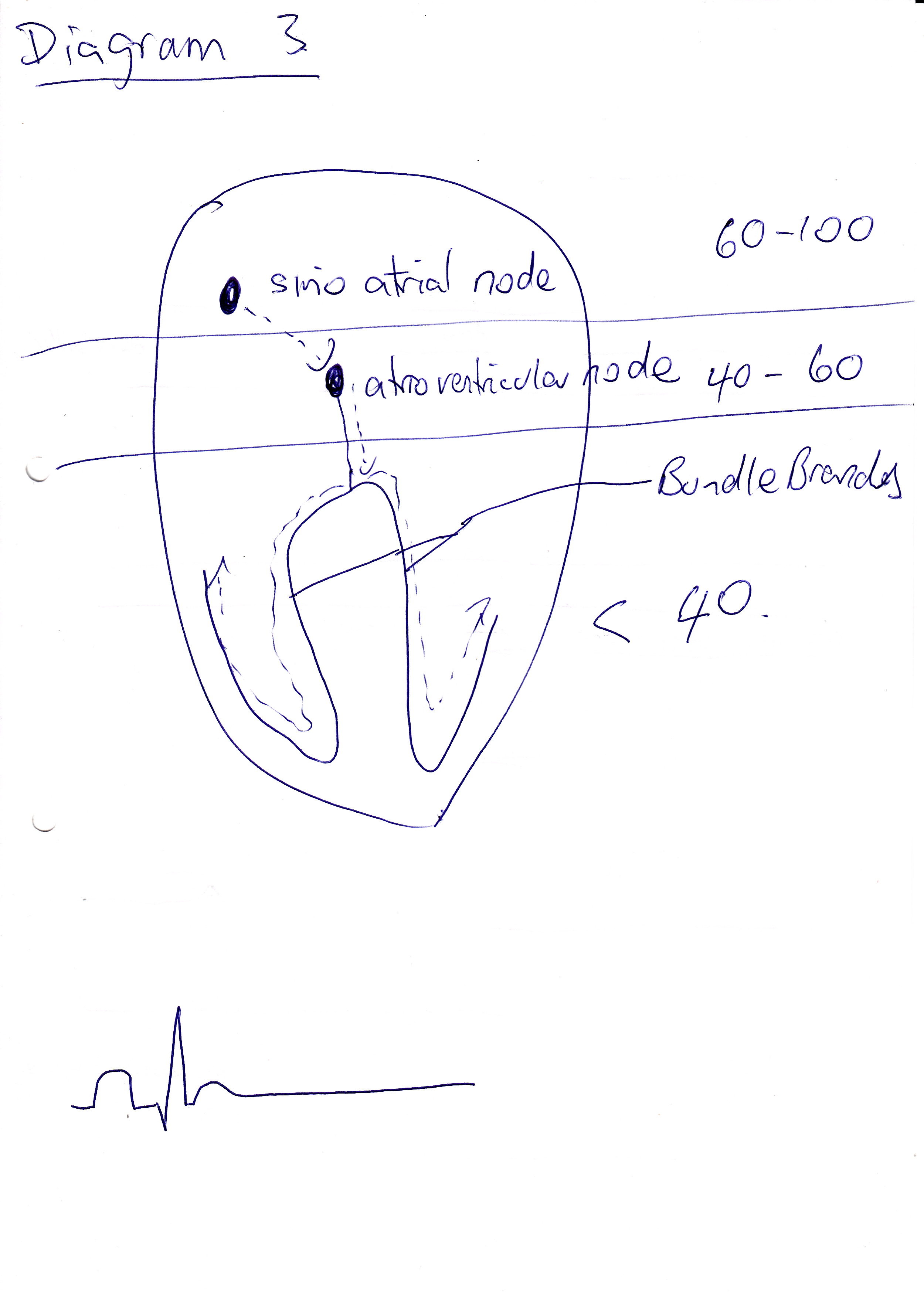
The heart has it’s own electrical system which is independent of the nervous system. Specialised muscles generate and distribute electrical impulses that stimulate the cardiac muscle to contract. Normally the two atria contract while the ventricles relax and then vice versa. The sino atrial node is the normal pacemaker of the heart because it sends out an impulse quicker than anywhere else. It then travels to the atrioventricular node and through the Bundle Branches in the ventricles.
If anything goes wrong every cardiac cell is capable of sending an electrical impulse. The top third will send impulses at 60 -100 beats / minute, the middle third 40-60 and in the ventricles at a rate less than 40. Fast heart rates are ones above 100 and slow ones under 60. Increase in exercise and slow rates in the very fit are normal. When the electrical system goes wrong arrhythmias occur. Atrial Fibrillation is an arrhythmia which originates in the atria. Numerous cells set themselves up as pacemaker and bombards the AV node with impulses. It controls how many get through to the ventricles. Fibrillate means quivering movement and this is what happens in the atria as there is no organised contraction.
The electrical movement can be looked at with a 12 lead ECG. This looks at the heart in different places and is a diagnostic tool. The rhythm strip in the above diagram is what is attached to you in hospital and is purely looking at the rhythm of the heart so arrythmias can be treated quickly where necessary.

© irene waters 2014
As already mentioned the heart has to receive oxygen like every other organ in the body and this is done via the coronary arteries. If there is a blockage in these vessels and the heart muscle does not receive sufficient oxygen angina will occur. This is a warning.
Angina typically is uncomfortable pressure, fullness, squeezing or pain in the centre of the chest. The discomfort may also be felt in the neck, jaw, back or arm. If exercising you should stop and rest. It should go.
If the pain that does not go after a maximum of 5 mins call an ambulance. The ambulance men are in a position to commence treatment immediately which could make a difference.
A Myocardial Infarction is what is commonly called a heart attack. This is where permanent damage occurs to the heart muscle. Time is critical in this instance as the heart muscle doesn’t die immediately but damage increases the longer the artery stays blocked. Delay may increase damage to the heart and decrease the amount of heart muscle that can be preserved. This increases the risk of disability. 88% of heart attack victims under 65 return to their normal work.
Certainly this is a very basic overview of the heart and for those of you who didn’t know I hope you now know what is affected when you hear people saying they have heart failure, or have had a heart attack or they have atrial fibrillation.
https://dailypost.wordpress.com/dp_writing_challenge/student-teacher/











 Reflections and Nightmares- Irene A Waters (writer and memoirist)
Ker-ikey !!!! I should print this and carry it ’round with me … 🙂 Goodonyer, Irene !!
LikeLike
Don’t worry, I’m not setting a test M-R.
LikeLike
Nono ! – I meant as a kind of help for anyone who finds me prone upon the ground. 😉
LikeLike
LOL
LikeLike
You would have done very well in my medical anatomy class!
LikeLike
Thanks. I didn’t realise that the post was quite opportune as it is National Heart Week here.
LikeLike
There are 6 defibrillators been installed at work, and I did the training to know how to use one. They said that you could not hurt anyone using a defibrillator. So I asked if I could try one out on my colleague and they would not let me. So what happens if someone used a defibrillator on me, when I am fine? Would it feel bad, or could it cause a problem for the heart?
LikeLike
Yes to both. I think the defibrillators that you use though have monitors which will only allow you to shock under certain circumstances. Am I right or can you just go around shocking willy nilly?
LikeLike
Yes they have a computer voice tells you whether the heart needs a shock, so i guess you probably can’t override it and shock your friends for fun.
LikeLike
Technology has probably improved significantly but we got one of the first machines that diagnosed rhythms and it wasn’t always right. But that was a long time ago. I was pleased to see that the cardiac surgeon we saw the other day used a manual blood pressure machine not an automatic. I’ve been telling Mum for years to get them to take her BP manually as the machines just aren’t accurate in her case and he confirmed it. I feel vindicated.
LikeLike
Very interesting and concise this, thanks Irene. My hubby has just completed his First Aid course at work so that he is now qualified to use a defibrillator, so he has been filling me in with all that he has learnt lately too! 🙂
LikeLike
Thanks Sherri. By the sound of it you’ll be up on everything via your contacts. Wish my husband would go and get some training. I feel with my family history I am much more likely to need his ministrations than him needing mine. Cheers Irene
LikeLike
It would be good wouldn’t it if we could all know what to do? I had some training many years ago through the American Red Cross when I worked in a dental office but I wouldn’t know what to do now, and anyway it all seems to have changed.
Hope your week is going well… cheers!!! 🙂
LikeLike
Anything is better than nothing Sherri. I could certainly not go nursing again as I don’t think I’d have a clue about the treatments anymore. I’m starting to get a feel for what I am doing so I guess it is going well. Hope yours is also. Cheers Irene
LikeLike